Salt Lake Sector V, Bidhan Nagar,
Kolkata, West Bengal India Pin - 700091
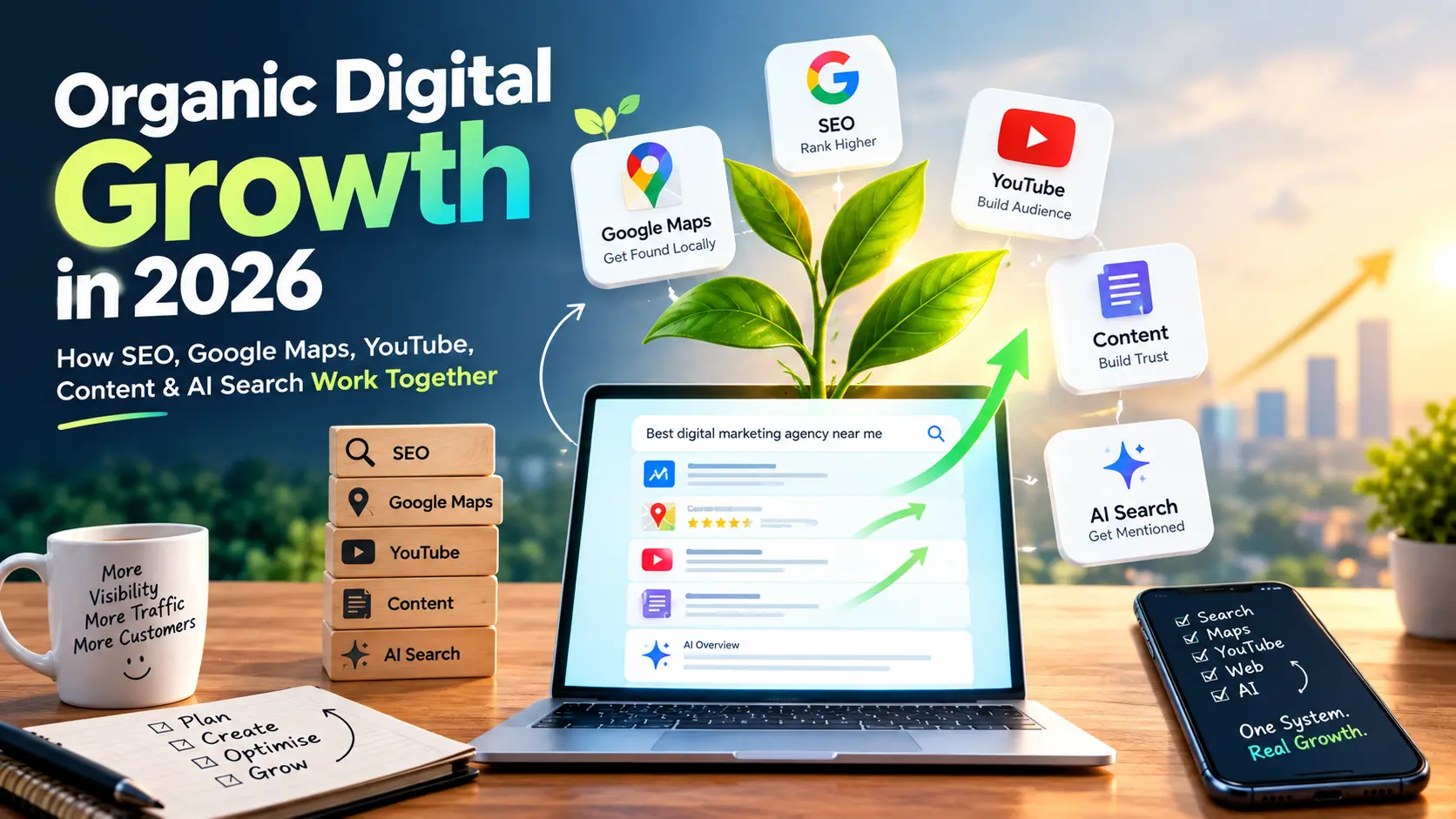
Organic digital growth is the visibility a business earns without any paid ads, over time, across search engines, Google Maps, YouTube, and now AI tools like AI Overviews and AI Mode. But there is no one-size-fits-all formula for organic growth. A local clinic, an e-commerce brand, a B2B consultancy, and an education business can all need SEO, but the way their customers search, compare, and make decisions can be completely different. It’s still common for agencies to split SEO, local search, video, and content into four distinct roles. That’s exactly why so many businesses feel stuck. The moment these pieces start working as one system, growth stops being a struggle and starts compounding on its own.
So if you’re getting decent traffic but the phone barely rings from a customer call, or a competitor with a messier website somehow shows up everywhere you look, this is worth reading properly. There’s usually a simple reason behind both problems.
Organic digital growth is the increase in visibility, traffic, and inquiries a business earns without any paid ads, spread across search, maps, video, and AI-driven discovery.
It’s not one thing though. It’s several things pulling in the same direction. Technical and content SEO makes a website easy for Google to crawl and understand. Local SEO and a properly maintained Google Business Profile get you found in Maps and “near me” searches. YouTube SEO puts you in front of people using what is, in practice, the world’s second-biggest search engine. Content marketing builds trust by actually answering the questions customers have. And AI search readiness decides whether a chatbot mentions your name when someone asks it for a recommendation.
Paid and organic growth serve different purposes. Paid campaigns can create immediate visibility, while organic growth can build visibility and authority that continue to compound over time. The strongest strategy isn’t about choosing one over the other; it’s about knowing where each channel fits.
It’s 2026 and the truth is that people are more aware than they’ve ever been. Suppose a customer finds you on Google maps then they will check your reviews maybe some will visit your Instagram profile or a quick glance at your YouTube videos to see if your website or product is legit or not, most probably they asks a Ai assistant they trust to compare you against your competitors, this cycle happens before they even pick up the phone or purchase your products. The scary part is if your business only shows up at one of those steps, you’re basically invisible for the rest of the journey.
Discovery has moved well past the ten blue links most of us grew up searching through. People are now putting their faith and trust into AI-generated answers, local map results, and video before they ever click through to a website.
A lot of this comes down to AI Overviews and AI Mode answering questions directly on the results page, sometimes before anyone even scrolls. People also search differently now. So instead of just typing some keywords like “SEO agency,” they’ll type or say something closer to “who has the best local SEO services near me,” full sentence, much more in a conversational tone.
Nowadays how consistently your business is described across the internet now plays a real part in whether an AI system feels confident enough to mention you at all.
That’s the honest “why now.” Businesses treating SEO, Maps, YouTube, and AI visibility as one connected job are the ones popping up everywhere. Everyone still focused on a single channel is losing ground quietly, even if their traffic report still looks fine this month.
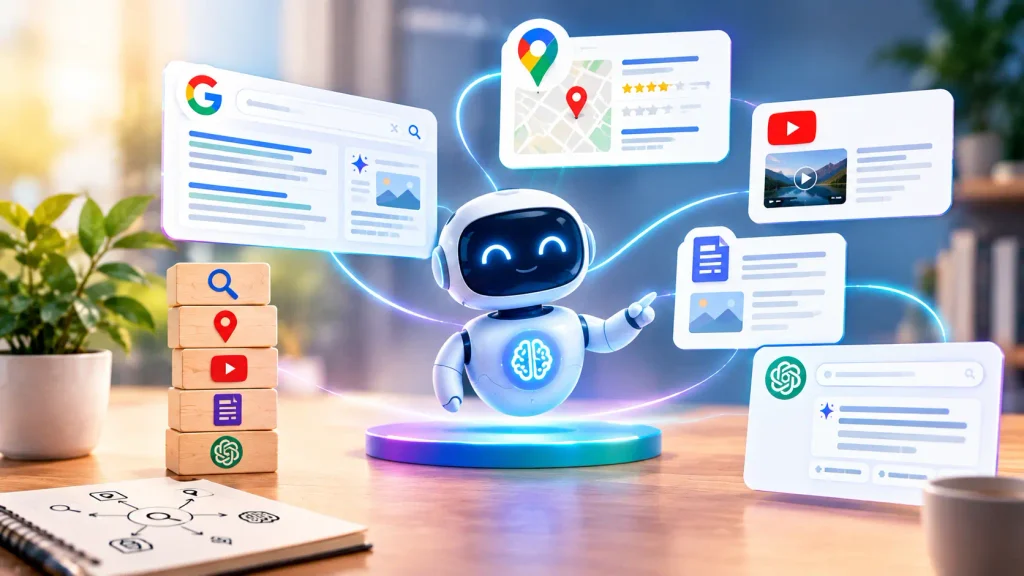
A proper organic growth system leans on advanced SEO, Google Business Profile optimisation, YouTube SEO, content marketing, and AI search readiness. Pull one of these out and the rest start to wobble.
Technical SEO isn’t glamorous, but it’s arguably the most important part, it’s the reason search engines can actually crawl, read, and rank a site in the first place. You can have the most amazing and beautifully written content in your website but if the overall user experience measures like site speed, mobile friendliness, structured data, clean indexation is missing from your website then even genuinely great content struggles to get anywhere.
An SEO audit is basically a health check for your website. An SEO audit highlights the crawl issues, the content quality , the backlink profile as well as any technical issues that your website has.
On-page SEO helps make the pages in your site easy to understand by optimizing the titles, headings, internal links, structure, so both a reader and a search engine can tell what the page is actually for within a few seconds.
The best link building services tend to focus on the quality of backlinks rather than the quantity of the backlinks as one link from a genuinely respected source usually beats a hundred low-quality ones, and most SEOs who’ve been doing this a while will tell you the same. Online stores need something a bit different again.
And SEO isn’t really a one-off job. Monthly SEO exists because algorithms shift and competitors keep publishing, so a strategy that worked in January can quietly stop working by June if nobody’s watching it.
Google Business Profile optimization means completing every profile section with clear accurate details of your business as well as updating the business profile with recent photos, any new updates or uploading any posts so that you can rank higher in your local search results.
Maps rankings come down to relevance, distance, and prominence. How well your listing matches the search, how close you physically are, and how well-known and well-reviewed you are compared to the business two streets over.
A lot of businesses only find out what’s actually wrong once they run a proper Google Business Profile SEO audit, checking categories, review activity, and photo frequency against local competitors instead of just guessing.
Google review management is the ongoing habit of encouraging genuine reviews, replying to every one of them, and keeping an eye on how that activity trends over time, since quantity, recency, and response rate all quietly influence local ranking.
YouTube SEO connects search intent, topic selection, packaging, content quality and viewer response.
Videos rank when good keyword targeting meets actual retention. A perfectly optimised title means nothing if people bail in the first ten seconds. To reliably rank YouTube videos, most businesses need keyword research done before filming even starts, editing built around holding attention, and a publishing habit rather than one video every few months whenever someone remembers.
The channel matters as much as any single video. A clear description, organised playlists, consistent branding, and a rhythm the algorithm can actually learn. This is where a youtube marketing agency earns its fee, tying keyword research, retention-focused editing, and channel strategy together instead of treating every upload like it exists on its own.
Content marketing is creating things that are genuinely useful, articles, guides, videos, aimed at building trust over time rather than pushing for a sale in paragraph one.
An SEO content strategy decides what gets written, in what order, and around which real questions, so the content builds into something with actual authority instead of turning into a pile of unrelated blog posts nobody links between. Done well, a content strategy and SEO approach starts from what customers are genuinely asking, not just what a keyword tool spits out.
There’s a distinction worth clearing up here, because people mix it up constantly. Copywriting marketing exists to persuade, to move someone toward a sale, a booking, a sign-up. Content writing, including SEO content writing, exists to teach and inform, and that trust is exactly what earns rankings over time. Put plainly, copywriting vs content writing comes down to intent. One’s selling, the other’s teaching, and a solid organic strategy genuinely needs both, used on purpose rather than swapped in for each other.
Content strategy supports SEO because a well-built article answers a real question, links to related pages, and reinforces what the whole site is about. Which is really the point. Content and SEO aren’t two separate disciplines fighting for budget. They’re the same effort described from two different angles which immensely helps in organic digital growth.
AI search optimization is about structuring content so tools like AI Overviews and AI Mode can actually read it, understand it, and quote it back when someone asks a related question.
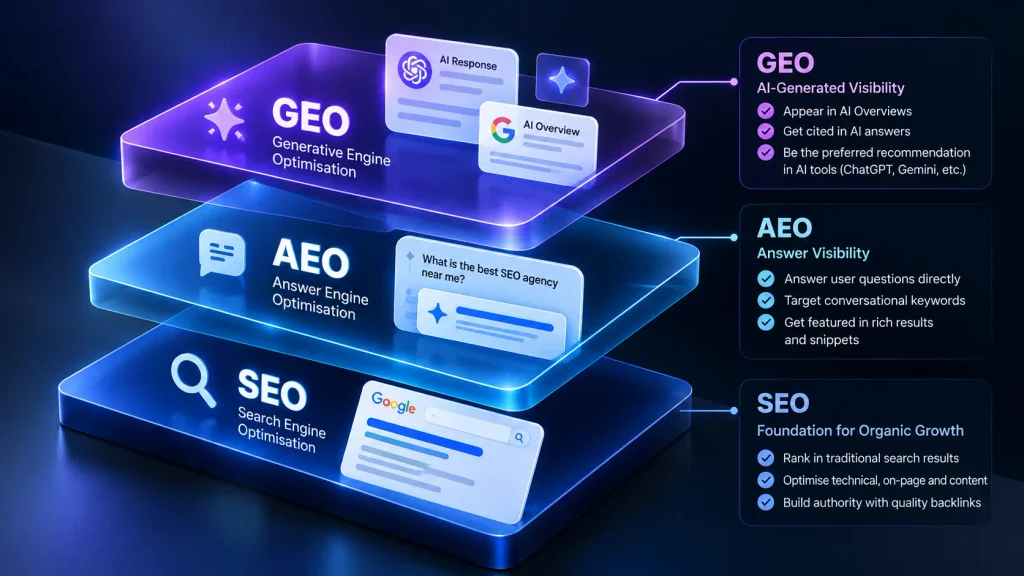
Generative Engine Optimisation, or GEO, goes a step further. It’s about helping improve how a brand and its information are understood and surfaced in generative AI answers.
Does GEO replace SEO? No, and it’s worth saying plainly because plenty of people will try to sell you otherwise. Google’s own guidance is that the same foundational SEO practices apply to AI features like AI Overviews and AI Mode, and there’s no separate technical trick that guarantees an AI mention. GEO builds on good SEO. It doesn’t skip past it.
| Approach | Main Purpose | Typical User Behaviour |
| SEO | Search visibility | Searches and clicks |
| AEO | Answer visibility | Asks questions, seeks direct answers |
| GEO | Generative/AI visibility | Asks AI systems for synthesised answers |
Think of it as three layers stacked on top of each other. SEO is the foundation. AEO takes that foundation and shapes it into clear, direct answers. GEO then carries that visibility into AI-generated answers, which now sit right next to, and sometimes above, the traditional results.
Nobody’s customer journey is one channel anymore, not really. It’s Google Search, then a Google Maps listing, then a YouTube video, then a page on the website, then a general sense of “these people seem legit,” then possibly an AI assistant weighing in, and only then a conversion.
Picture someone searching, checking your Maps reviews, watching a video to see if you’re the real deal, reading a blog post to understand what’s actually included in the service, and then asking an AI tool to compare their shortlist before they ever dial a number. Show up at only one of those steps and you’re effectively absent for the rest of the decision, no matter how good that one step is.
Organic digital growth almost as a loop rather than a checklist. You start by figuring out where your audience actually searches, then work out their real intent and the questions they’re asking.
From there you strengthen the technical SEO, the content, the Google Business Profile, and the video presence. Then you build direct answers around those real questions, and work on the trust and consistency that make a brand feel credible.
Once that’s in place, visibility naturally spreads across Search, Maps, YouTube, and AI discovery, which is when enquiries start turning into actual customers. And then you measure what worked and go around again, because none of this is a one-time project.
This tends to follow a fairly natural sequence.
Start with proper research into the business and its competitors, then map out audience intent. Build the technical SEO foundation, then the content architecture, then local search, then a real YouTube presence. Layer AEO and GEO thinking on top of that, then focus on authority building more broadly. Somewhere in the middle of all this, keep an eye on conversion, and measure everything along the way rather than waiting until the end to check if it worked.
Rankings alone don’t tell you much anymore, honestly. You’ll want SEO metrics like impressions, clicks, click-through rate, and organic traffic, For AEO, monitor visibility for question-based searches, featured-answer appearances where measurable, and engagement with answer-focused content. As GEO measurement is still evolving, businesses should focus on measurable signals such as brand mentions, citations, referral traffic and available AI-search reporting rather than relying on a single GEO score.
Google has started rolling out reporting for generative AI search visibility to some Search Console users, which means this is slowly becoming something you can measure properly rather than something you just have to trust is happening.
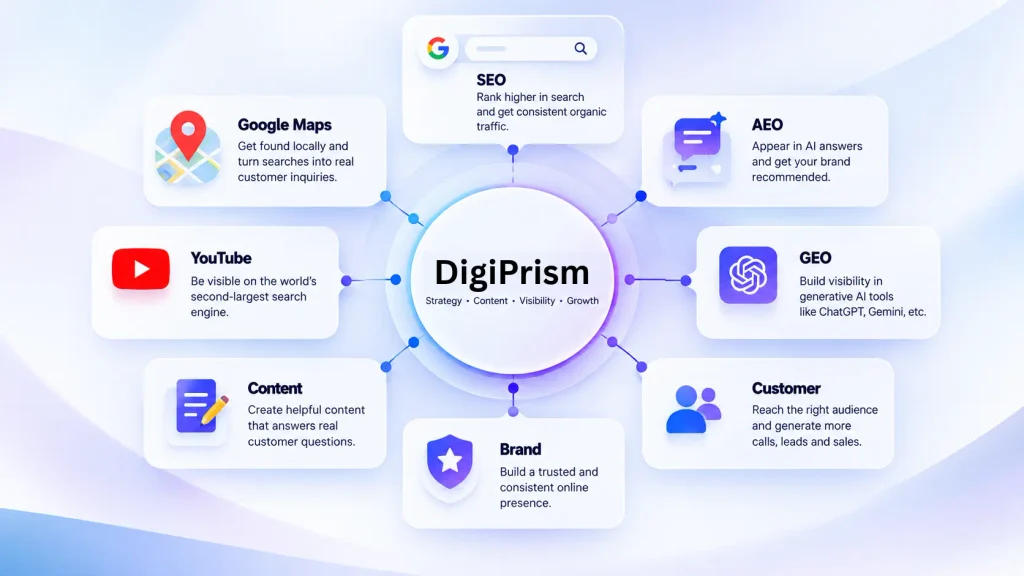
At Digiprism, we believe organic growth works best when digital channels are connected but the strategy itself needs to be shaped by the genre, industry, audience, and business objective.
That means creating a website that search engines can understand.
Creating content that customers actually want to read.
Building a Google Business Profile that accurately represents the business.
Using YouTube to demonstrate expertise.
Building a consistent brand presence.
Answering customer questions clearly.
And creating an information ecosystem that can adapt as search continues to evolve.
The objective isn’t to chase every algorithm update.
It isn’t to publish hundreds of articles just to increase the page count.
And it isn’t to find a shortcut that guarantees visibility in an AI answer.
The objective is much simpler:
Build a digital presence that deserves to be discovered.
When SEO, local search, YouTube, content, AEO and GEO are treated as connected parts of the same strategy, organic marketing becomes more than a traffic channel.
It becomes a long-term growth engine.
If your business is visible in only one place, you’re depending on one discovery path.
A stronger strategy connects the places where your customers actually search, learn and make decisions.
SEO + Google Maps + YouTube + Content + AEO + GEO
That’s the foundation of a modern organic digital growth strategy.
Build Your Organic Growth Engine With Digiprism
Let’s Talk.
It’s the visibility and customer enquiry a business achieves without any paid ads, across search results as well as Maps, YouTube, and AI-powered discovery, working together rather than as separate efforts.
Yes, of course. SEO is still the foundation of everything else including the AEO and GEO.
It puts you in front of nearby people searching with real intent, often at the exact moment they’re ready to choose someone.
Yes, and often more easily than on traditional SEO. AI systems tend to favor clear, consistent, well-sourced information over sheer domain size, so a small business with accurate details and a genuinely helpful reputation across the web can get cited just as readily as a much bigger competitor with a messier online footprint.
A structured overview of the key concepts, strategies, technologies, and practical insights discussed in this guide
Organic digital growth combines SEO, Google Business Profile, Google Maps, YouTube, content marketing, and AI search to build lasting digital visibility, discovery, and customer enquiries.
Organic growth strategies should be shaped around the business, industry, audience, search behaviour, and customer journey rather than applying the same marketing approach to every business.
Technical SEO, on-page optimization, website architecture, indexation, structured data, internal linking, content quality, and relevant backlinks form the foundation of organic search visibility.
Google Business Profile optimization strengthens local visibility through accurate business information, relevant categories, services, photos, updates, reviews, and ongoing profile management.
YouTube SEO combines search intent, topic selection, keyword research, content quality, titles, packaging, viewer retention, channel optimization, and consistent publishing.
SEO content strategy connects real customer questions with useful articles, guides, and resources to build topical authority, trust, and organic visibility.
AI search optimization and GEO focus on making a brand’s information clear, consistent, useful, and understandable across AI-powered search and generative answer experiences.
SEO focuses on search visibility, AEO focuses on answer visibility, and GEO focuses on generative or AI visibility. These approaches can work together as part of a broader search strategy.
Modern customer journeys can move across Google Search, Google Maps, YouTube, websites, content, social media, and AI assistants before a customer makes a decision.
Digiprism approaches organic growth as a connected system shaped by business understanding, search intent, technical SEO, content, local and video discovery, authority, conversion, measurement, and continuous refinement.
Organic growth can be evaluated through search impressions, clicks, organic traffic, local interactions, YouTube performance, brand mentions, citations, enquiries, conversions, and other relevant business outcomes.
Digiprism builds digital strategies by genre and industry, connecting relevant channels around the audience, market, and business objective instead of using a one-size-fits-all marketing model.
Turn ideas into growth with the right digital marketing strategy.
Let's Talk Growth