
Salt Lake Sector V, Bidhan Nagar,
Kolkata, West Bengal India Pin - 700091

Honestly the reality is that a business can spend years building its reputation. Then lose a chunk of a customer’s trust in about four minutes flat. We’ve watched it happen enough times that it genuinely stopped surprising us a while back.
Sometimes it’s a bad review sitting there unanswered.
Sometimes it’s just an old search result nobody bothered updating, a complaint that never got a reply, a wrong phone number on some directory from 2019, an article that got half the facts right and half wrong, or honestly, just… not much information about the company at all once someone actually goes looking.
And now there’s a newer wrinkle sitting on top of the old ones.
In this new age of AI bloom a potential customer doesn’t just Google you anymore. They might ask an AI assistant what it thinks of your company.
Then maybe compare you to two competitors in the same category, without even opening a new tab. A little review reading here and there. Some stalking around your Instagram for thirty seconds and probably then deciding if you’re worth an actual phone call or not.
That’s a lot more steps than there used to be.
So now what does online reputation management even mean?
It used to be mostly about page one of Google, let’s be honest. But not anymore, or at least not only that. Now it’s about whether there’s enough consistent, believable evidence scattered across the internet that a total stranger can look at your business and think, yeah, these people seem legit.
Your online reputation is whatever impression people form about you from whatever they can dig up. That’s a bigger net than most business owners think, and honestly, it keeps getting bigger every year.
Part of it is you control yourself. Like your website. Your Google Business Profile.Also the Instagram, LinkedIn, whichever platform you actually use. Your blog, if you keep one updated. YouTube, if you’ve got a channel. Whatever you choose to announce yourself. That’s the manageable part.
The harder part is everything else. Reviews people leave on the internet in various user platforms. Industry blogs you’ve never heard of. Random forum threads from three years ago that somehow still rank on page one. Someone’s offhand comment on social media that gets more engagement than anything you’ve ever posted. Directory listings you honestly forgot existed. A video a customer filmed on their phone and uploaded as a reel. Community chats happening in group threads you’re not even in. And now, AI-generated answers pulling from all of the above at once, sometimes accurately, sometimes not even close.
So no. Reputation isn’t just a bad one star rating.
It isn’t one search result sitting at the top either. A business with a gorgeous website and genuinely bad reviews has a problem, however nice that website looks on somebody’s phone screen.
A business with five-star reviews but almost nothing else credible floating around still struggles, because reviews alone don’t always close the gap for people who are genuinely on the fence. And a company that lands great press but has mismatched info scattered everywhere else still leaves people a little unsure, even when every individual piece technically checks out.
It’s the whole picture. Not any single piece of it on its own.
The path a customer takes before buying anything has gotten genuinely messier. Ask anyone working in the marketing department and they’ll say the same thing without needing a slide deck to prove it to you.
One person finds you through a quick google search, checks your google business Profile, reads a handful of reviews, visits the site, pokes around social media, maybe looks for something independent, then finally decides.
Another person starts researching about your brand on YouTube instead and never touches Google at all. A third just asks an AI assistant and skips half those steps entirely, which is becoming less rare by the month, not more.
Businesses are getting judged across a handful of surfaces at once now. Not one website. Not one search result sitting pretty on page one.
AI search makes this trickier still. An AI-written answer can stitch together info from several places before a customer ever clicks through to your actual site. A lot of current thinking in reputation circles is starting to treat those AI answers as their own separate surface now, sitting right next to search, reviews, news, and social, instead of some gimmick worth ignoring for another year.
Here’s a question worth actually sitting with for a second though. If someone researched your company from five different starting points today, right now, would they land on five slightly different stories?
Or one clear, consistent one no matter where they started?
That consistency matters more than most teams currently treat it. And most won’t notice the gap exists until a customer points it out directly, which, trust us, is never a fun way to find out.
Here’s a mistake we run into constantly, almost weekly honestly. Businesses confuse being visible with being trusted.
Those aren’t the same thing, no matter how good the follower count looks on a screenshot.
A business can have thousands of followers, a slick website, a decent pile of backlinks, hundreds of reviews, maybe a bit of press. And still struggle to turn any of it into actual paying customers, because the overall picture doesn’t quite add up once someone looks closely. This happens more often than most businesses would ever admit out loud.
Think of it almost like a rough equation, nothing scientific.
Visibility, plus evidence, plus consistency, plus the actual experience people have, adds up to something close to trust. Weaken any one piece and the whole thing starts to wobble, no matter how strong the rest looks on paper.
Visibility is just whether people can find you at all.
Evidence is whether there’s proof backing up whatever you claim about yourself.
Consistency is whether your info tells the same story everywhere it shows up.
And most importantly experience, the big one really, is whether what customers actually go through matches the reputation you’re trying to build around it.
That last piece outweighs everything else. Genuinely. You can’t build something lasting on top of a weak customer experience, no matter how sharp the content strategy looks on a review deck. Marketing gets people to notice you exist. Reputation decides what they actually think once they’re looking closely.
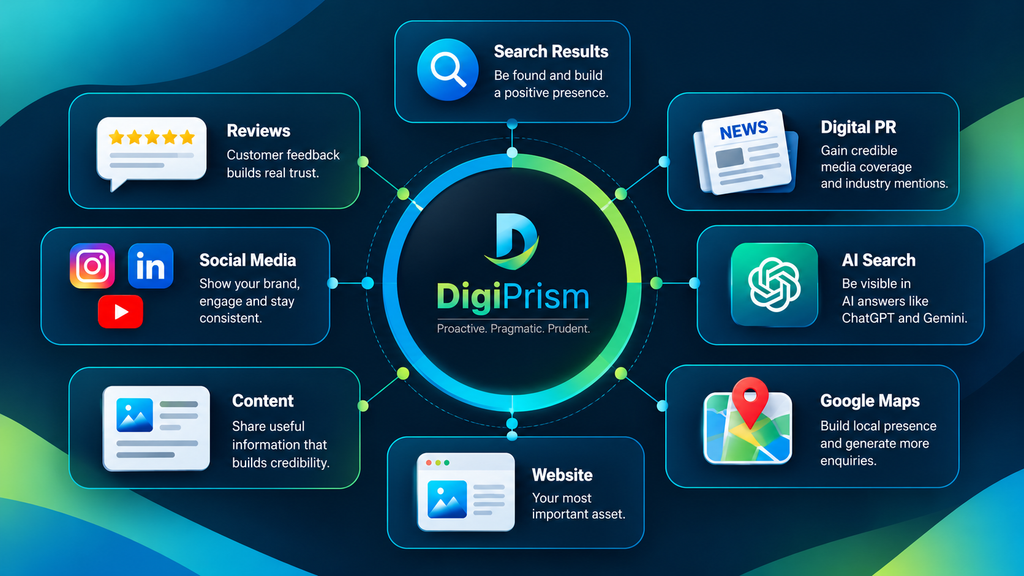
Instead of treating reputation management like one big vague task sitting untouched on somebody’s to-do list for months, it helps to break it into specific signals and work through them one at a time.
Go on the search bar and type your own brand name. What shows up? More importantly, what shows up besides your own website?
Worth a look: the brand name , the founder’s name, your products or services by name, location searches, anything plus “reviews,” competitor comparisons, news results, images, videos, and whatever random third-party pages happen to be ranking right next to you without anyone’s permission.
Branded search results work like a digital handshake, whether that was ever the plan or not. Stumble onto outdated info, an ignored complaint, or two contradictory descriptions of what you actually do and that shapes somebody’s opinion before they’ve even said a word to you directly.
So step one’s genuinely simple. Search your own name like you’re a total stranger who’s never heard of the business before. Actually look at what comes up, instead of scrolling past it because you already know the “real” story in your head.
Reviews are about the most public form of feedback a business will ever get. There’s really no avoiding them at this point, not in 2026.
But chasing five-star reviews as a pure numbers game misses the point entirely.
The better question is different: what do customers keep saying, over and over, without anyone prompting them to say it?
Patterns matter more than any single rating ever will. Do people keep mentioning how fast you respond? How do the staff treat them? The actual quality of the product? Delivery times? Pricing? Communication? What happens once the sale’s already done? Those repeated themes tell you more than a star average ever could, full stop.
Reviews flag problems before they become bigger problems down the line. Funnily enough, they flag strengths too, ones your own marketing team sometimes hasn’t even clocked yet. Google’s own advice is simple, reply, keep it relevant, keep it professional, keep it useful, and they’ve pointed out that a natural mix of good and bad feedback actually reads as more trustworthy than a suspiciously flawless five-star sheet anyway.
So stop treating reviews like a number stuck next to your business name. They’re free customer intelligence, basically. Use them that way.
Your website tells people what you say about yourself. Useful, sure, but limited by definition. Third-party coverage tells people what somebody else is saying about you, and that lands completely differently every single time.
Which is exactly why digital PR does so much heavy lifting for creating a brand reputation, even though businesses keep underrating it year after year.
Good coverage comes from industry specific publications, business press, local news, expert interviews, founder stories, research pieces, podcasts, events, and the professional communities a business is genuinely part of, not just invited to once and never again.
The goal was never to just “get a backlink” and move on with your day.
Better framing: earn third-party evidence that actually backs the brand up, link attached or not. Digital PR these days leans a lot more into brand authority, mentions, and AI visibility than the old link-building playbook from a decade ago ever did.
That distinction matters more than it sounds like it should. A mention in a publication people actually trust can shift how someone sees your business even if they never click through to read the actual article.
Your website’s the one spot where you actually control the story, which makes it a bit of a wasted opportunity when all it does is try to sell, sell, sell.
A decent website answers the questions already running through someone’s head before they’ll ever commit to anything.
Who are you, really?
What do you actually do, in plain terms?
Who do you usually work with?
What’s different about your approach?
How much actual experience is behind this?
Where are you based?
What backs up the claims sitting on the page?
And when somebody’s finally ready, how do they reach you?
Good content fills that gap nicely. Case studies, expert write-ups, a properly built FAQ, original research if you’ve got any, real info about the actual team, project examples, transparent pricing or service details. It all adds up to something clearer over time, piece by piece.
The point was never to sound impressive. It’s to sound believable, which, weirdly enough, is a different target than most briefs seem to aim for.
People check social profiles before reaching out, and they’re not expecting a million followers, not everytime. What they’re actually looking for is proof the business is real and they can trust it with their money, still active, relevant today, not three years ago when somebody last posted something.
It could mean recent posts. Or genuine replies in the comments. The content that’s useful rather than purely promotional.
May some glimpse of actual humans behind the brand. Demos of what you sell. Real customer stories. Participation in whatever community the business genuinely belongs to.
A profile gone quiet for two years sends a very different signal than one that’s clearly still being looked after. Social presence is part of reputation here. Full stop. Not just a channel to neglect between campaigns and dust off whenever it’s convenient.
Inconsistent information creates confusion nobody sets out to cause on purpose. And yet it happens constantly, almost by accident, nobody even notices until a customer brings it up.
Picture finding three different descriptions of the same company. The website calls it a digital marketing consultancy. LinkedIn says it is a full-service creative agency. A directory lists it as an advertising company. An AI answer somewhere calls it an SEO provider, for some reason.
Technically all four could be loosely true at once.
But now the customer has to piece it together themselves, and most people simply won’t bother doing that work. That’s a clarity problem hiding in plain sight, usually invisible until someone finally points it out, often a prospect who just walked away confused.
Worth checking regularly: your business name as it appears everywhere, your description, listed services, locations, who’s named as leadership, how you’re positioned in the industry, contact details, the general language you use to describe yourself. The bigger the brand gets, the more this consistency actually starts to matter.
This one’s genuinely new, and most businesses haven’t quite caught up yet, which, fair enough, given how fast it’s all moved in the last year or so.
People now ask AI tools whether a company’s trustworthy, what it actually does, which option they should pick, what alternatives exist, what people are generally saying about it. The answer might get pulled together from several sources at once, stitched into something that reads confidently even when parts of it are flat-out wrong.
Which means a business can’t think about reputation purely in terms of what it publishes on its own channels anymore. It has to think about the wider information environment sitting around the brand, most of which it never fully controls and, realistically, never will.
Current thinking increasingly treats AI-generated answers as an emerging reputation surface worth watching closely. But here’s the catch, and it trips people up constantly. You can’t just “optimise” your way into a good AI answer the way you’d tweak a meta description and wait for Tuesday.
The real work is the underlying evidence. Clear brand info. Genuinely useful content. Consistent business details. Honest reviews. Relevant third-party mentions. Real expertise signals. Accurate profiles. Credible references. AI visibility should be the outcome of a strong digital presence, not a shortcut around actually building one.
Quick detour before we get to the practical steps, because online reputation management isn’t the same job for every business, and most of the generic advice out there acts like it is. It’s not. Not even close, really.
Healthcare is a good place to start. A healthcare brand runs on trust signals that stretch well past star ratings (the stars are probably the smallest piece, if I’m being honest). Somebody choosing a clinic wants to see credentials, they want proof of real outcomes, and above all they want to know who exactly is going to be treating them. A track record that still looks good when someone pokes at it a bit. It feels personal, that decision, in a way buying a toaster never does, so people go digging. Properly. Sometimes a bit obsessively, and who could blame them.
A B2B consultancy is a whole other animal. Buyers there take forever, or it feels like forever, and usually half a committee has an opinion before anyone signs a thing. So demonstrated expertise, case studies and recognition from outside the company end up counting for more than how many reviews are sitting on some profile.
Then the local service business, your plumber, your dentist, that restaurant near your place. Google reviews and Maps visibility pretty much run the show here, because the decision gets made fast and close to home, and let’s face it, nobody has the patience to scroll past the first few reviews on their screen.
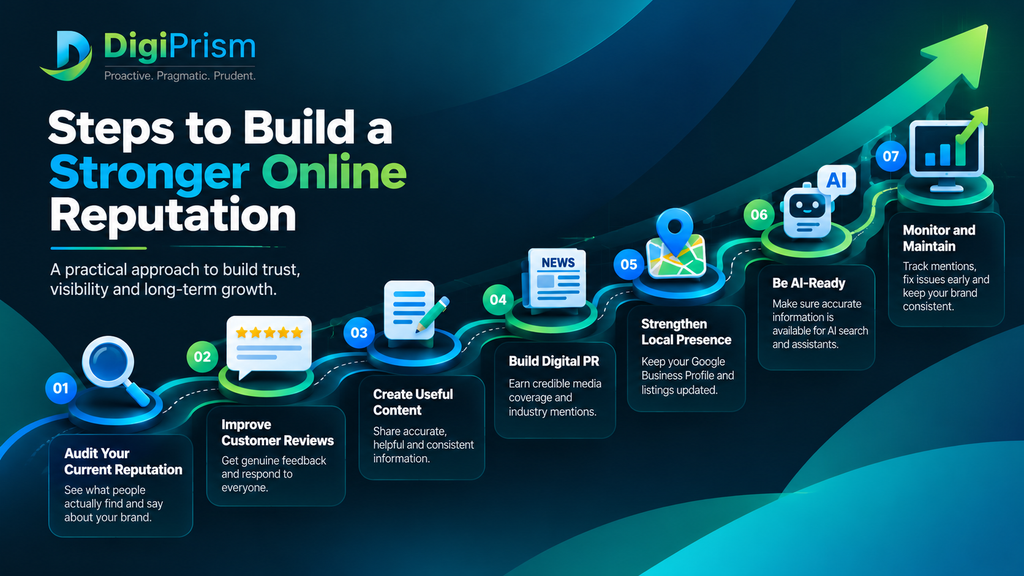
Now here’s some tips and tricks that you can actually use.
Hold off on creating content. I know you want to. Hold off anyway.
Type in the company name, just the name, and see what comes back. Then the name plus “reviews.” Then “complaints.” After that, try your location along with your main services. Do the founder’s name as well, and your biggest products while you’re already at it.
Read that first page properly, then keep going. The truth is the more honest picture about your brand or business tends to hide a little further down in the search results than anyone expects.
Keep a small notepad or notes app open and active. Write down what’s good, what’s bad, what needs updating, any mentions that make you go “huh,” patterns in the reviews, whatever catches your eye.
That list is your baseline. Everything later gets measured against it.
Once you’ve searched the brand properly, it helps to sort what you found into actual problems. If you don’t, they all blur together into one vague worry, and a vague worry is close to impossible to act on.
A trust gap usually means there just isn’t enough proof out there anywhere. An information gap is when something important is missing or confusing. A consistency gap means different places tell slightly different stories about the same business. A review gap, simply, is when not enough genuine feedback is coming in. And an AI visibility gap means the AI answers floating around are incomplete, out of date, or flat-out wrong.
Sorting it like this changes how the whole thing feels. “We need a better reputation” is perfectly true, and also, where do you even start? “We’ve got an authority gap and a review-response gap” is something a team can pick up this week. Not maybe someday in late autumn.
Say the brand claims it’s good at something. Okay, fair. But where’s the proof actually sitting? Someone’s going to ask at some point right? and “just trust us” isn’t going to cut it when they do.
This proof might be a real experience of a client, case studies, original research, measurable results for actual past clients, expert commentary, industry recognition, press coverage or honestly any work you’ve put out in public.
This is exactly where experience, expertise, authority and trust stops being just industry buzzwords and starts meaning something. Google’s own guidance leans hard on these qualities and it’s noticeably cooler than any content created only to chase search traffic.
So skip announcing that you’re trustworthy and hoping it lands. Give people enough actual evidence that they get there themselves. That kind of trust sticks. The other kind, well, it kind of doesn’t.
Waiting around for customers to remember to leave a review doesn’t really work. Most of them mean to. Then the day happens.
So build an actual process for asking, and try to do it soon after a meaningful interaction, while it’s still fresh in their minds.
There’s a line here though, and it’s not worth crossing. Don’t buy reviews. Don’t hand out rewards for positive ones. And please, most of all, don’t write fake reviews yourself or nudge the ratings in some way that would be properly embarrassing if it ever came out. Because it usually does, sooner or later.
Google explicitly bans fake and incentivised reviews, and it bans selective solicitation too (only asking the happy customers, basically) when it’s designed to game the numbers. Getting caught tends to cost a lot more than it ever saved anyone.
A reviews and feedback strategy shouldn’t live in some Word document, completely cut off from how the business actually runs day to day.
Picture customers who keep complaining about slow replies. You could write twenty social posts about how deeply the business cares about its people. Or you could fix the response time.
The second one does more, obviously. It’s also less exciting, and it won’t make a nice screenshot for anyone’s content calendar, but that’s rather the point.
Feedback shows you operational problems, product issues, communication gaps, expectations that don’t match reality. Then you fix the real experience, and not only the messaging wrapped around it like a bow.
Reputation gets a lot stronger when outside sources can vouch for the business on their own, rather than everyone simply taking your word for it. People trust other people more than they trust a brand’s own copy. Always have, really.
Forget the generic press release. Most journalists ignore those anyway, and have for years. Look for expert commentary opportunities instead, interviews, original research the business could actually produce, data-driven stories, roundups, podcasts, trade publications, industry communities, local press, and events worth turning up to in person (not just RSVPing and then quietly staying home).
The best digital PR story is almost never “Company X launches another service.” Nobody outside the building cares about that, genuinely nobody. A much stronger angle sounds more like “Company X has real insight into a problem the whole industry’s dealing with,” because that’s something people want to read and then pass along to a colleague.
A crisis management plan that only starts once the crisis is already public is too late. Everyone watching can tell. Every single time.
Instead try to create a basic framework in advance while things are calm.
When something disastrous does hit, verify what actually happened before you react to whatever’s being said online. Correct anything factually wrong and quickly. Talk clearly to whoever needs to hear from you, customers, staff, stakeholders, whoever’s affected. Watch whether it’s spreading or fading by itself. And afterwards, actually learn something from it, find the real cause and what has to change.
The aim during a crisis was never to “win the internet” whatever that would even mean in practice. It’s to cut through the confusion, communicate responsibly, and protect the relationship with the people who were actually affected.
In reality one bad review doesn’t automatically mean the reputation is forever wrecked, even if it feels that way the second the notification lights up your screen. What matters much more is how you handle the situation.
Before you reply, work out what kind of review you’re looking at. Genuine criticism? A misunderstanding? A legitimate complaint? Spam? Something abusive, or something that just breaks the platform’s own rules?
Well if it’s genuine criticism, the worst thing you can do is get all defensive right away. Tempting for sure, but please don’t. A solid response generally does four things, roughly in this order: acknowledge it, clarify what happened, offer help, and move forward together.
A genuine remove negative reviews service always advises to keep the reply as human as possible . Not robotic and too not corporate-sounding. And keep in mind that the reply is public as well, read by far more people than the one who left the review.
Google’s guidance is to keep responses professional, relevant, clear, useful and never defensive, and it really does show when a brand sticks to that advice consistently.
Sometimes, yes, if it clearly breaks the platform’s rules. But “just remove every bad review we get” was never a real strategy, and it rarely works the way people hope.
Google draws a fairly clear line between genuine feedback and the stuff that’s actually prohibited: fake engagement, incentivised reviews, outright manipulation, and a handful of other categories worth knowing about.
The sensible version is pretty simple. Remove what truly breaks policy. Respond properly to what’s legitimate, even when it stings a little to read on a Monday morning. And learn from whatever turns out to be useful, because most negative reviews carry at least a kernel of something worth paying attention to.
It’s far more sustainable than quietly trying to erase every bit of criticism, which backfires the moment customers spot the pattern. And they do spot it. More often than businesses assume.
Monitoring needs to cover more than social mentions, which is where plenty of businesses quietly stop looking and call it done.
At the very least, keep an eye on the brand name alone in search, plus “reviews,” plus “complaints,” plus the founder’s name in case something unexpected turns up. For reviews that means Google, of course, but also relevant industry platforms, marketplaces, local directories, not only whichever one is easiest to check on a Monday morning before coffee.
Media coverage counts too. Brand mentions, founder mentions, wider industry pieces that talk about the business without even quoting it, which does happen. Social monitoring should catch mentions, comments, complaints and general chatter, even when nobody bothers to tag the business in the post itself.
And then there’s AI search, which is worth testing on purpose and not stumbling into by accident one random afternoon. Ask the relevant tools what the brand does, whether it seems reliable, what its strengths are, what the alternatives look like, what customers tend to say about it.
Reputation won’t squeeze into one tidy number, however much a dashboard might want to pretend it will. Better to build something small around a handful of signals that mean something to the business.
For search, track branded impressions, branded clicks, how your important positions are trending, and how visible the positive or neutral pages are next to anything negative sitting close by.
And for reviews, track the volume, rating trends over time, the response rate and whichever themes keep coming up month after month without fail, like clockwork almost.
Digital PR is a bit different. Relevant mentions matter, as does the quality of the publications involved, general brand mentions, editorial links, expert citations picked up along the way. Content-wise, organic visibility, engagement, assisted conversions and brand searches round out the picture.
AI visibility is newer ground. Watch how often the brand appears in relevant AI answers, how accurate those descriptions are, which sources keep getting cited, how the business compares with competitors in that same space.
None of it matters all that much, though, unless it ties back to real outcomes in the end. Enquiries, leads, calls, visits, sales, retention, real confidence from actual customers. A dashboard that looks fantastic on a slide but never connects to any of that is measuring activity. Not progress.
This one’s number one for a reason, and you lose that fight before it even starts.
Nobody controls every conversation about their business online. Not with any budget, not with any team. What you can influence is smaller and much more useful: the experience, the information, how you respond, the evidence you put out there. That’s honestly the whole list.
Businesses slip into this without noticing (I’ve seen it happen in the nicest, most well-meaning teams). A rating is handy at a glance, sure. But the words people actually write? They tell you far more than the number ever will.
You get two problems for the price of one here: trust takes a hit, and you’ve landed in policy violation territory that’s really hard to walk back once it’s public. Genuine feedback is the only foundation worth building on. Everything else wobbles.
A quiet one, and easy to overlook. Nonstop self-promotion doesn’t build much evidence of anything worth trusting. So teach something. Explain something. Show what you actually know, and please don’t try to sell in every single post that goes out.
Your website is one slice of the picture. Just one. However polished it looks on screen. So make sure the third party sources back you on the image of the brand or business that you are trying to create.
Honestly most of the businesses learn this exactly once, the hard way, and usually in public. So build the framework for the crisis early, while things are calm and everyone can still think straight.
The truth is AI visibility should grow out of a credible digital presence, naturally. It isn’t a shortcut around building natural digital presence in the first place.
This misleads businesses about their own progress more than most people realise. Ten irrelevant mentions on low-quality sites are often worth less than one credible mention landing in front of the right audience, in the right context and importantly from the right person. One good one beats ten forgettable ones easily.
At Digiprism, reputation gets treated as one connected system and not a pile of disconnected tasks handled by whoever happens to have a spare hour that week.
It starts with discovery, which is just working out what customers, search engines, platforms and third parties are showing about the brand. Right now. Today. Not maybe six months back, when nobody was really looking. From there it moves into a detailed analysis, where you pinpoint the gaps like the trust gaps, information gaps, review problems, authority gaps, and any risks quietly sitting under the surface.
Next comes strengthening. That means improving not only the website content or layout but a complete improvement of the business profiles, customer experience and general brand information, based on whatever the analysis shows up. After that comes building real evidence through reviews, case studies, demonstrated expertise, press coverage and credible third-party mentions that back up every claim being made out loud.
Then responding and communicating. Real processes for reviews, complaints, misinformation, anything that starts emerging, so it gets handled before it spirals. And when damage happens anyway (and sometimes it does, however well prepared you are), recovery is about facts, context, transparency and steady communication.
Last is monitoring. Keep tracking search results, reviews, media, social and AI-generated information and keep doing it. It’s not a one-off audit that gets filed away and forgotten by March.
Here’s the part that matters most, though. It doesn’t stop at monitoring, which, honestly, is where a lot of reputation work quietly dies. What you learn has to flow back into the actual business. Customers keep raising the same issue? Fix the issue. Skip the apology post. People keep misunderstanding what the business does? Fix the positioning instead of waiting for them to figure it out. No credible evidence of real expertise anywhere online? Go build some, deliberately, on purpose. AI systems keep getting the description wrong? Take a look at the information sources around the brand rather than hoping it sorts itself out.
Reputation management earns its keep the moment it starts creating real improvement in the business. Not when it’s managing appearances from a comfortable distance and hoping nobody looks too closely.
These channels really shouldn’t sit in separate departments. Yet that’s exactly how most businesses still organise them, on some org chart drawn up years ago and never touched since.
Picture a customer researching a B2B company before they get in touch. They search the name. Read the website. Check a few reviews, hunt around for independent coverage, look at LinkedIn, maybe watch a video if there’s one, compare a couple of competitors side by side, ask an AI assistant what it thinks, and only then do they reach out.
Every one of those steps adds another piece of evidence to the picture forming in that person’s head. Which is really why reputation has got so tangled up with SEO, content, digital PR, social, reviews and AI search. It doesn’t sit off by itself anymore, waiting for something to go wrong.
Nobody’s sitting there thinking “right, now I’m doing online reputation research,” obviously. They’re thinking one simple thing: can I trust this company or not? That’s the only question your whole digital presence has to answer. However many channels it takes to get there.
At Digiprism, we don’t think reputation gets built through one channel. Or through some shortcuts, right before a launch date nobody planned for properly.
Anything from a local business to a healthcare brand ,an ecommerce company, a B2B consultancy or an education business. They’re all up against genuinely different reputation challenges, even if they’re technically chasing the same goal underneath all that.
So reputation strategy has to start with recognizing the nature of business itself, not with some generic checklist lifted off the internet and adapted without much thought. Get to know the industry first. Understand who the audience really is (not who you assume it is). Take some time and effort and understand the real customer journey. Find the trust gaps honestly, even the uncomfortable ones. Build the evidence on purpose. Strengthen the actual experience, not just the words wrapped around it. Then, and only then, connect all the channels into one working system.
Online reputation was never about looking perfect. Nobody believes perfect anyway, and most people get a little suspicious the moment something looks too polished. What matters is that the digital picture is clear, credible and trustworthy wherever somebody first bumps into it, whatever time of day that happens to be.
And in a search world that AI is increasingly shaping, that picture has to hold together no matter where somebody starts looking. Not just on the one page a business happens to control.
Build a reputation that doesn’t only look good the moment someone searches for you. Build one that gives them a real reason to trust you once they dig a little deeper.
Online reputation management is the ongoing work of monitoring, understanding and improving how a business comes across on search engines, reviews, social platforms, media, websites and everywhere else digital.
Start by checking what customers actually find when they search for you. Then strengthen the website and the basic business info, encourage genuine feedback, respond properly to reviews, build credible third-party visibility, and publish content that’s useful (really useful, not filler). Keep watching the signals that matter most in your particular industry.
Yes, and pretty directly. Reviews are public proof of real customer experiences, and they shape how people see a business before anyone’s even spoken to it. What’s written in them also tends to surface recurring issues that are worth fixing.
Only when they genuinely break the platform’s rules or are otherwise eligible for removal under its policy. Legitimate negative feedback usually deserves a professional, thoughtful response and, where it makes sense, a real attempt to fix whatever went wrong in the first place.
Digital PR builds third-party credibility by earning real media coverage, expert mentions, interviews, editorial references and other independent recognition. The value was never really the raw number of links picked up along the way. It’s the quality and context behind the recognition itself.
AI-powered search and answer tools summarise brand information by pulling from several sources at once, sometimes quite loosely. So businesses increasingly need to watch not just traditional search, reviews and media coverage, but also how accurately and consistently their information shows up across the wider web.
Your online reputation is the impression people form about your business from search results, customer reviews, websites, social media, third-party mentions and AI-generated answers.
Customer reviews reveal recurring strengths, problems and customer experiences. Responding professionally and using feedback to improve the business helps build trust.
Digital PR builds credibility through industry publications, business press, local news, expert interviews, podcasts and other relevant third-party mentions.
A business website should explain who you are, what you do, who you work with, what makes your approach different and what evidence supports your claims.
An active social presence and consistent business information help people understand the brand. Conflicting descriptions, outdated details and inactive profiles can create confusion.
AI tools can combine information from multiple online sources to describe businesses and compare alternatives. Clear brand information, useful content, genuine reviews and credible third-party references help support a consistent digital presence.
Monitor branded search results, reviews, media coverage, social mentions and AI-generated answers. Measure progress through relevant visibility, review trends, credible mentions, enquiries, leads, sales and other meaningful business outcomes.
When reputation problems arise, verify the facts, correct misinformation, communicate clearly and respond professionally. Lasting recovery requires identifying the cause and improving the underlying customer experience.
Reputation is a connected system, not a collection of disconnected marketing tasks. SEO, reviews, digital PR, content, social media, customer experience and AI search all contribute to how people perceive a business.
Build a reputation that gives people a real reason to trust your business once they look a little deeper.
Turn ideas into growth with the right digital marketing strategy.
Let's Talk Growth